
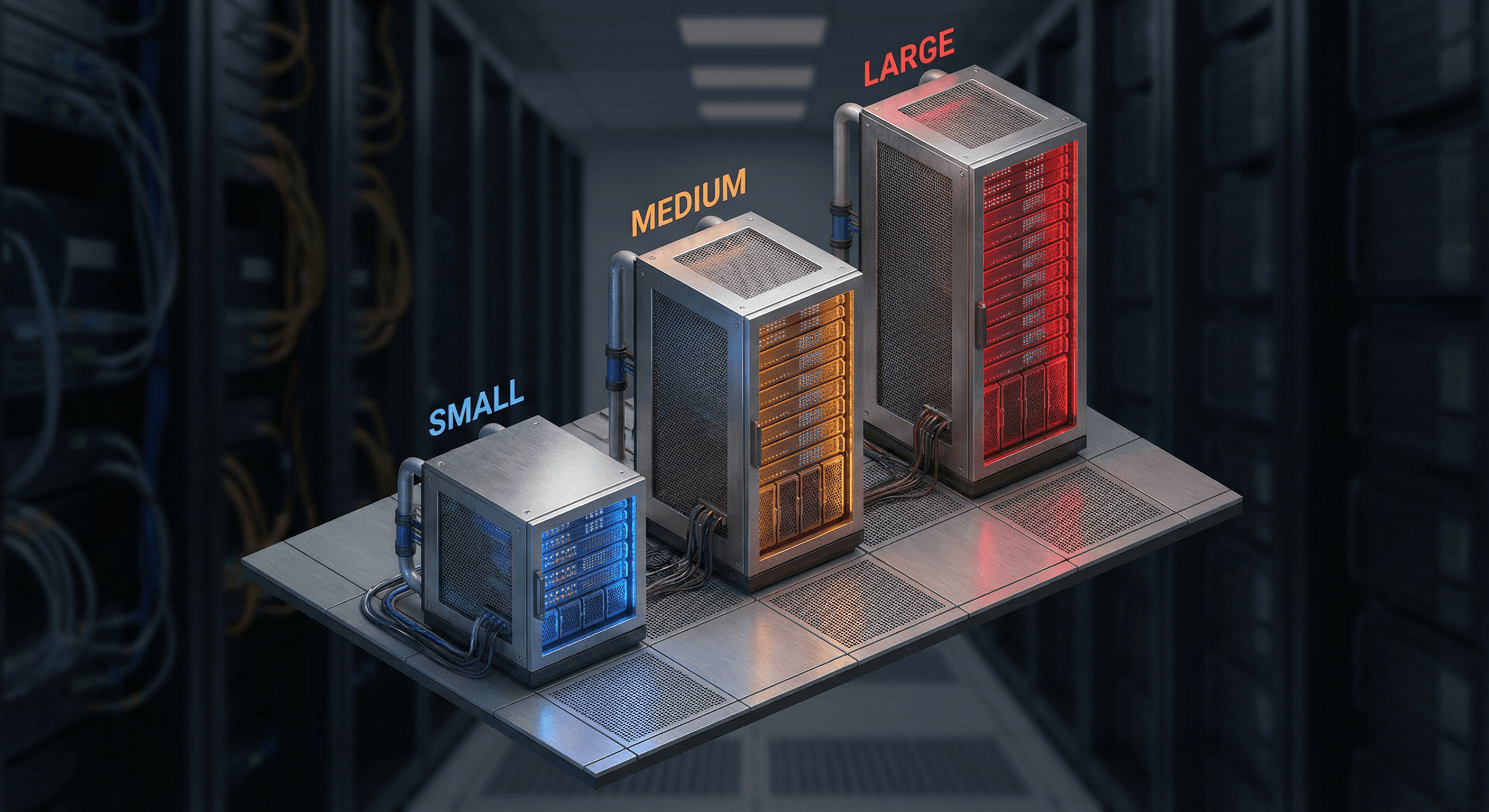
Understanding the Server Spectrum
Choosing between VPS, VDS, and dedicated server hosting is a fundamental infrastructure decision that affects performance, cost, and operational complexity. The right choice depends on your specific workload requirements, budget, and technical expertise — and the wrong choice means either overpaying for unused capacity or under-provisioning for your needs.
This guide provides a comprehensive technical comparison to help you make the right decision for your specific situation.
VPS (Virtual Private Server): The Versatile Workhorse
A Virtual Private Server (VPS) is a virtualized environment running on a shared physical host. A hypervisor (KVM, VMware, or Hyper-V) partitions the physical server's resources among multiple VPS instances, with each instance receiving guaranteed allocations of vCPU, RAM, and NVMe storage.
How VPS Virtualization Works
Modern KVM hypervisors provide strong resource isolation. When you get 4 vCPUs and 8GB RAM on a VPS, those resources are allocated to your instance and not available to other tenants. CPU scheduling ensures your vCPUs get their guaranteed time slices even when the host is under load. Memory is fully dedicated to your instance. Network bandwidth is managed via traffic shaping to enforce your allocated limits.
VPS Performance Characteristics
- CPU: vCPUs are time-sliced from physical cores. Performance is consistent for sustained workloads but may see brief spikes when host CPU is fully contested. For most web applications and APIs, this is not a practical limitation.
- Memory: Fully dedicated. No sharing with other tenants.
- Storage: NVMe-based VPS storage provides 400,000+ IOPS — excellent for database-backed web applications. Storage may be network-attached (NVMe over Fabrics) enabling live migration and redundancy.
- Network: Shared uplink with bandwidth allocation per plan. Suitable for most web traffic profiles.
VPS Best For
- Web applications and APIs
- Small-to-medium databases (PostgreSQL, MySQL under 100GB with moderate concurrent load)
- Development and staging environments
- Email and collaboration servers
- SaaS applications serving under 10,000 concurrent users
- Any application where the economics of full dedicated hardware aren't justified
Data Mammoth's CloudCore VPS plans start at $11.99/month for 1 vCPU / 2GB RAM / 25GB NVMe. See our pricing page for the full plan comparison.
VDS (Virtual Dedicated Server): Near-Bare-Metal Performance
A Virtual Dedicated Server (VDS) provides virtualized resources with dedicated physical CPU cores — not time-sliced vCPUs but actual physical CPU cores exclusively assigned to your instance. This eliminates CPU sharing with other tenants entirely, providing performance characteristics much closer to bare-metal dedicated servers.
VDS vs. VPS: The Key Difference
The fundamental distinction is CPU isolation:
- VPS vCPU: Virtual CPU that shares physical cores with other VPS instances via time-slicing. Performance excellent on average, occasional brief contention under host-wide peak load.
- VDS dedicated core: Physical CPU core exclusively assigned to your VDS instance. No sharing, no contention, fully consistent performance regardless of what other VDS instances are doing.
VDS also typically uses locally attached NVMe storage (direct PCIe connection) rather than networked storage, eliminating the network hop for storage I/O and providing maximum IOPS performance.
VDS Best For
- High-frequency trading and financial applications requiring consistent latency
- Large production databases (PostgreSQL, MySQL with high concurrent transaction load)
- Real-time applications (gaming servers, live streaming, WebRTC)
- CPU-intensive workloads (video processing, scientific computing, ML inference)
- Applications where CPU performance variance is unacceptable
Data Mammoth's DedicatedCore VDS starts at $109.91/month for 4 dedicated cores / 32GB RAM.
Dedicated Servers: Maximum Performance and Control
A dedicated server is an entire physical machine exclusively for your use — no virtualization, no sharing, complete control over hardware configuration. You have direct access to physical CPUs, memory, and storage with no hypervisor overhead.
Dedicated Server Performance
Dedicated servers provide:
- Maximum CPU performance — all physical cores exclusively yours, no virtualization overhead
- Maximum RAM — all physical RAM exclusively yours
- Maximum storage I/O — locally attached NVMe with full physical bandwidth
- Maximum network I/O — full physical NIC bandwidth
Dedicated Server Best For
- High-traffic applications serving millions of users
- Very large databases requiring all physical RAM (1TB+ database servers)
- Compliance requirements mandating physical isolation from other tenants
- Workloads requiring specific hardware configurations (GPU cards, high core count CPUs)
- License-based software priced per physical core (Oracle, SQL Server)
The Decision Matrix
| Factor | VPS | VDS | Dedicated |
|---|---|---|---|
| Price | $12-150/mo | $110-380/mo | $300-2000+/mo |
| CPU consistency | Very good | Excellent | Excellent |
| Physical isolation | No | Partial (CPU) | Full |
| Provisioning speed | Minutes | Hours | Hours-Days |
| Scaling flexibility | High | Medium | Low |
| Best for | Most web apps | High-perf workloads | Enterprise/specialist |
For most businesses, a VPS provides excellent value and more than sufficient performance. Upgrade to VDS when CPU consistency or dedicated core performance is specifically required. Consider dedicated servers for enterprise-scale workloads, compliance-mandated isolation, or specialized hardware needs. For plan details and benchmarks, see our VPS hosting and VDS hosting pages.